
Some Different Ways of Looking at Driver Data
Driver Data: How Looking at it Differently can be Helpful
Most of the time when I see people analyzing their data, they are looking at Time Distance Graph with all the normal squiggly lines – RPM, Speed, Steering, Throttle, Brake, and Gear. Exhibit 1 shows what I’m referring to here.
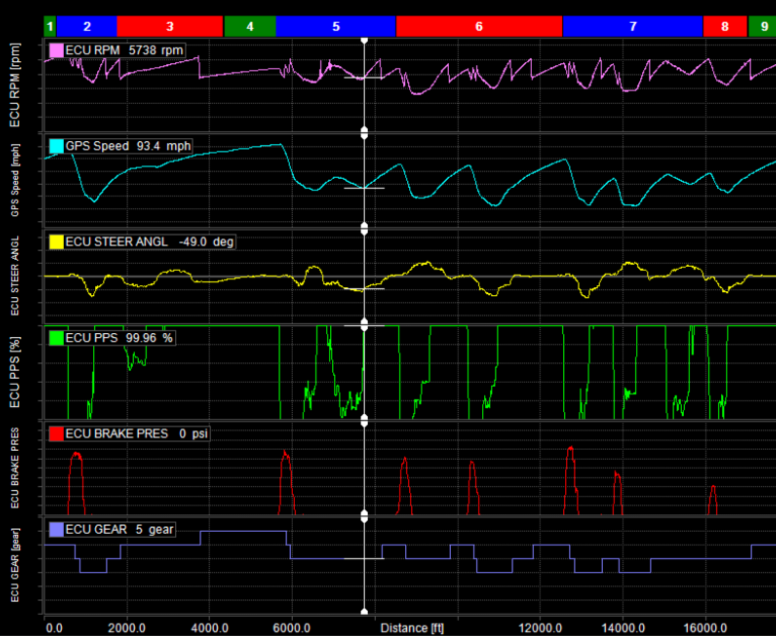
Exhibit 1
This type of data analysis certainly provides a lot of value but sometimes looking at the data a little differently opens your eyes a little bit more. In this article I’m sharing some of my favorite alternative ways of looking at driver data. One of my favorite ones is the Throttle Histogram chart. The chart that I like to use shows the percentage of time that the driver spends at different levels of throttle. Exhibit B compares one lap at Watkins Glen from a pro driver (red) to a amateur driver (yellow).

Exhibit 2
The Y axis is percent throttle and the X axis is the percent of time of the lap that the driver is staying at the throttle percentages. In this case, the pro driver’s lap time was about 3.5 seconds faster than the amateur’s lap time. There isn’t much difference between the two from the 30% to 90% throttle range. However, it is clear to see that the amateur driver is spending more time in the 10% to 30% range – about twice the amount of time is spent in that range. Interestingly, the amateur driver is off throttle (0% to 10%) for less time than the pro driver. But the most important area to look at is full throttle (90% to 100%) and the pro driver is at full throttle for more time than the amateur driver. The way I would interpret all of this is that the pro driver is more patient with initial throttle application but as soon as he feels like he has the grip he needs, he gets to full throttle as soon as he can. The amateur driver is probably getting to some throttle a little too soon and is a little bit more apprehensive about getting to full throttle. I love this as a driver coach because I could give the amateur driver a goal of something like 1% more full throttle and if he can do that then he would most likely be faster.
Track reports are another favorite of mine and I have found that these really resonate with people because they can see exactly where on the track something is happening. One of my favorite track reports is the Coasting Track Report.

Exhibit 3
Exhibit 3 shows the coasting differences between the pro and the amateur drivers. There doesn’t appear to be major differences between the two but there are a few corners that stand out to me. The first one is turn 10 because the pro driver’s coast is much more deliberate. We aren’t seeing brake pressure here but the pro driver is not touching the brakes and the amateur driver is. Also, the amateur driver has more coasting going into Turns 1 and 8. However, the amateur driver’s coast looks more deliberate going into the Bus Stop. Again, this is just another way to look at the data and sometimes looking at something like this leads to more questions and guides you to other paths of figuring out what is happening and what needs to be done differently to go faster.
Another one of my favorite charts to look at is a channels report showing the distances for Braking, Coasting, some Throttle, and Wide Open Throttle (WOT). These are calculated by assigning either a 1 or a 0 for on or off to each one of these with a math channel and then multiplying this result by (Speed [mph]/3600)*5280 — this equation converts speed in mph to ft/sec. Since a lap time is in seconds, if you take the Lap Integral of the result then this will give you the total number of feet over a given lap. For example, here are the two math channels that I use in AIM RS3 Analysis to get the distance for WOT:
WOT: IF(GT(“Throttle”, 98 [%]),1,0)
Distance WOT: lap_integ(“WOT” * “GPS Speed”/3600) * 5280
The differences between the pro driver and the amateur driver is shown in Exhibit 4.

Exhibit 4
The chart shows that for each of the driver’s fast laps the pro driver’s total distance is slightly less (33 ft) and the Distance Coasting is almost the same – only a 3.4 ft difference!
Interestingly, the pro driver broke 174.5 ft longer and was at some throttle 674.7 feet less than the amateur driver. However, the pro driver was at wide open throttle 487.6 ft more. This shows how important it is to be at full throttle for as long as possible!
As you can see, there are many different ways to look at data and sometimes looking at it a little bit differently can resonate more than just looking at the squiggle lines.
Good luck in your races!