
Why Are You Lifting
Why Are You Lifting?
Unless you are going from the throttle pedal to the brake pedal, or instead of braking for a fast corner you are doing a lift off of the throttle pedal in order to transfer weight to the front tires, lifting is probably a red flag. There is always a reason why drivers lift and many times my job as a driver coach is to figure out why and see if I can help the driver reduce the amount of lifting.
Many times, drivers lift simply because they aren’t comfortable with the speed they are going as they approach a fast corner that can actually be taken flat out. Summit Point Raceway in West Virginia was my home track for many years and turn 4 or “The Chute” was almost always the first rung on the ladder of turning a fast lap time there. It is a fast right-hand corner going downhill with a very slow left-hand corner at the bottom of the hill. Exhibit 1 shows Summit Point with the GPS Altitude trace shown as well. This shows that the track is dropping about 31 feet – which is almost four stories!
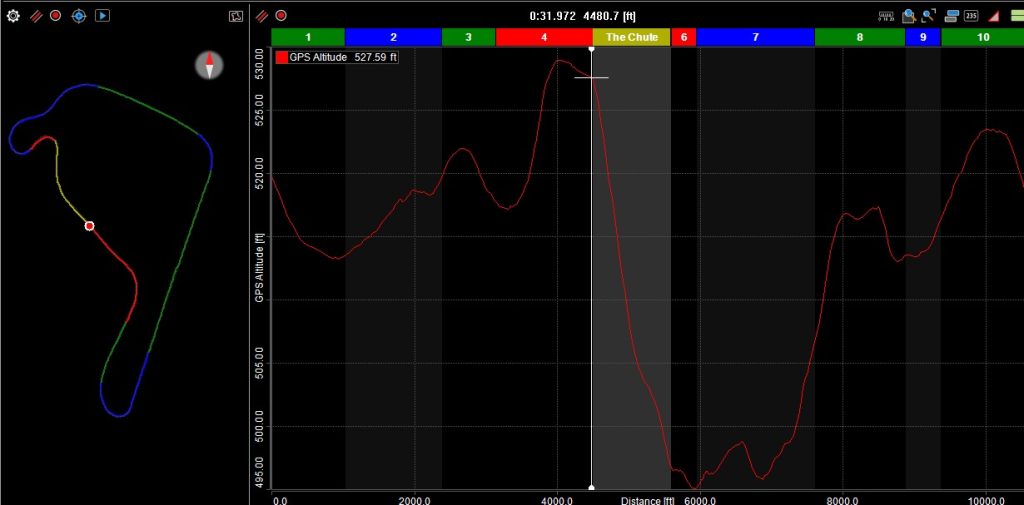
When I started racing, I was driving a Formula Vee and The Chute is easily full throttle in a Formula Vee. But it is not unusual to have a psychological barrier about staying full throttle – and I certainly experienced that. My mind would say this is easy flat as I was approaching the corner and then my right foot would say – “NOPE, I have to LIFT!!” Lol
So, how do you get your foot to do what your mind says it can do? Many times it is just a matter of muscle memory and convincing your foot that it can stay full throttle. How I did it, and what I recommend to my clients, is to slow the car down more well before the corner and then stay full throttle through the corner. You can then keep slowing the car down less and less well before the corner until you are full throttle approaching the corner and then through the corner. Usually, once you do it, your foot realizes that it was no big deal and you can do it each successive time you go through that corner!
Another psychological aspect that I see a number of drivers do is starting to lift off of the throttle prior to hitting the brakes for a corner that they know requires a lot of braking force to get the car slowed down enough for the corner. This probably isn’t going to cost a lot of time – I think the most I have seen is about a .01 seconds. However, it is unnecessary and sometimes .01 seconds is all you need to qualify ahead of your competitor. Plus, if this is done at 10 corners around the track then that is .1 seconds and that can certainly make a difference in qualifying order!
Another driving trait that I see a lot of is going to throttle too soon because the driver is not patient enough or simply isn’t recognizing the tires aren’t ready for throttle application yet. This can turn into “hobby horsing” – meaning that there are a number of lifts off of the throttle pedal prior to getting to full throttle. Exhibit 2 shows the throttle traces of a pro driver (in blue) and an amateur driver (in red) coming out of the same corner in the same car.

As can be easily seen, the amateur driver is much more aggressive with their throttle application and ends up lifting off of the throttle many times prior to getting to full throttle. The pro driver is much smoother. The amateur driver is not recognizing that every time they lift off of the throttle, they are transferring weight across the tires. Stiff race cars don’t like this very much and it can actually induce handling issues. In this case, the amateur driver does get to full throttle sooner, but it was easier for him to do that because he was going much slower than the pro driver in the middle of the corner.
Lifting off of the throttle can also indicate that there is a handling issue with the car and a setup change might be in order. In Exhibit 3 I have circled the pro driver “pausing” his throttle application.

The reason why he is pausing is because he is feeling that the car is understeering and he knows that if he goes to throttle anymore then the car will just understeer more and he will have to do a more significant left. By pausing, he is doing a much better job at managing the weight transfer and not causing any other handling issues. I suspect that he also knew that the car was going to have understeer at that point in the corner because he had already experienced it the lap before. If the pro driver thought that the car was understeering too much exiting corners, then a setup change could be made to reduce the corner exit understeer.
If you find that you are lifting, take some time and try to figure out why and work on how you can reduce it – I can almost guarantee that you will go faster! Good luck in your races!