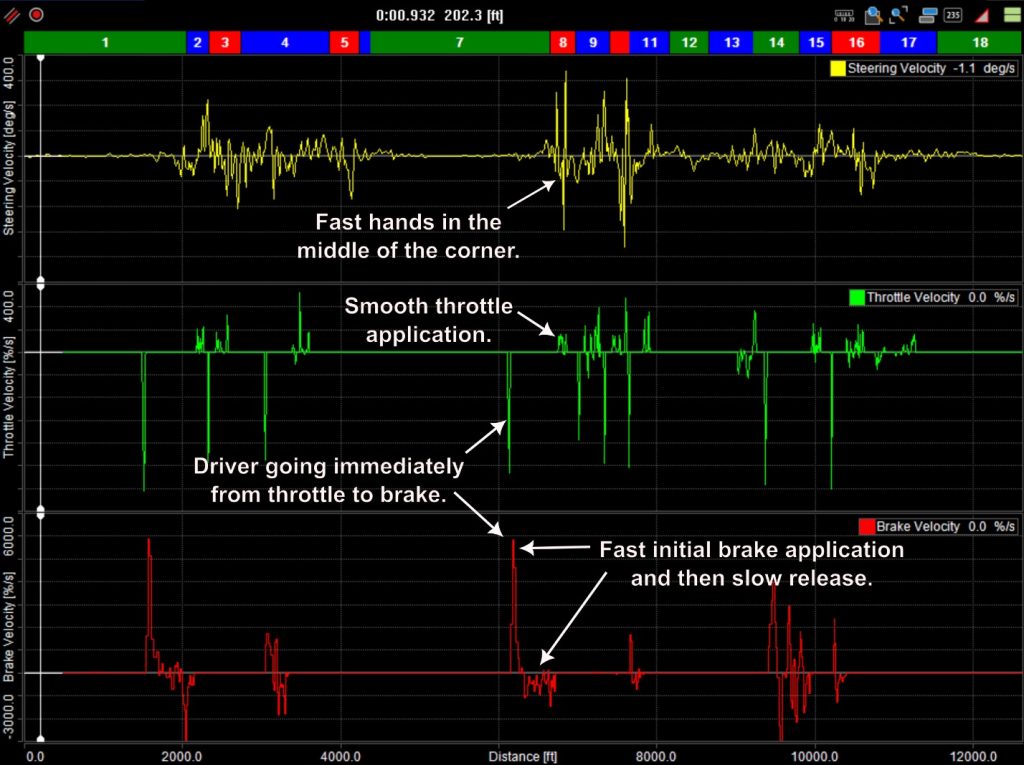
In my last article I talked about one of my favorite math functions which was the Integral function. In this article I’m talking about another favorite math function of mine, the Derivative function. When you take the derivative of a channel, you are calculating the speed or velocity at which it is changing. For example, one of my favorite charts is one where I plot Steering Velocity, Throttle Velocity, and Brake Velocity. Exhibit 1 shows this chart.
Exhibit 1
I have included some notes in Exhibit showing what I’m able to pick out just by looking at this chart.
Another chart that I like to use is an XY plot graphing steering velocity vs lateral g velocity. This is an interesting one because it is basically showing how hard the driver is working in the car. Lateral G velocity tells you how quickly the car is moving underneath the driver and steering velocity is showing how quickly the driver is reacting to the car’s movement. Exhibit 2 shows this graph for the same lap that is used in Exhibit 1.
Exhibit 2
The lines leaving the inner bunch of lines indicate that this driver is working pretty hard in the car. This was a pro driver that is very comfortable with driving the car at the limit. Exhibit 3 shows the same chart but only for the same corner that my notes are pointing to in Exhibit 1. However, I have zoomed in so show exactly what happens when the driver is making a fast correction with the steering wheel in order to catch the back end of the car. The colors in the graph indicate the lateral G velocity with blue being the slowest and red being the fastest. The cursor is at the beginning of this event. The pink arrows indicate the start of the back end stepping out. The colors have gone from blue to green indicating that the change in lateral Gs is picking up speed. And then the orange indicates that the change in lateral G’s has gotten even faster but the driver is still steering into the corner. At this point, the driver realizes that he needs to steer into the skid in order to catch the back end. As you follow the trace, you will notice that the colors move back to being blue which means that the car is now settled back down and the driver can continue to steer the car around the corner. Btw, all of this happened in 1.09 seconds!
Exhibit 3
In my opinion, the speed at which things are changing can be extremely important. How can you use the Derivative function?