
Mustang Challenge at Le Mans
From the Driver's Seat to France's Streets
One of the cool parts of being a Performance Engineer and Driver Coach is that I get to travel to some amazing places I might not have otherwise visited. This time, I was invited to support Robert Noaker Racing for the inaugural Mustang Challenge race at Le Mans, France. A special thanks goes out to Bob Noaker for bringing me along for the ride!
Although Bob had mentioned the possibility several months prior—especially since he might have five cars at the event—as the days counted down, I wasn’t sure it would actually happen. But just a couple of weeks out, the client running the fifth car confirmed, and that’s when I got the call from Bob asking if I could help with data and coaching. Plus, the fifth car was brand new and needed a VBox HD2 system installed, which I would bring with me.
So, I booked my flight, got a rental car, and Bob’s wife, Katie, helped me find a place to stay. It turned out to be a renovated 200-year-old farmhouse about 40 minutes from the track. I live about 30 minutes from Raleigh-Durham International Airport (RDU), and Delta offers direct flights to Charles de Gaulle (CDG) nearly every day. I flew out at 6:15 p.m. on Monday and arrived in Paris around 8:30 a.m. Tuesday morning, with testing scheduled for Wednesday.
It took a while to get through customs at CDG, and figuring out where to pick up the rental car was a bit of a challenge, but I eventually got on the road around 11 a.m. I headed straight to the track. After dealing with traffic, stopping for lunch, and some GPS confusion (lol), I arrived around 3 p.m. and immediately started installing the VBox HD2 system in the brand-new Mustang Challenge car.

Needless to say, I was exhausted—but still thrilled to be there. Forty Mustang Challenge cars were lined up under two long, open-sided structures—basically large carports. There were three classes: Dark Horse, Dark Horse Legends (drivers over 45), and Dark Horse Stars. The first two classes always run together, but the Dark Horse Stars class was added just for Le Mans and featured big names like Tanner Foust, Sir Chris Hoy, Chris Harris, Frankie Muniz, Chelsea DeNofa, and Ford President and CEO Jim Farley. With all cars being identical, the races were guaranteed to be exciting!
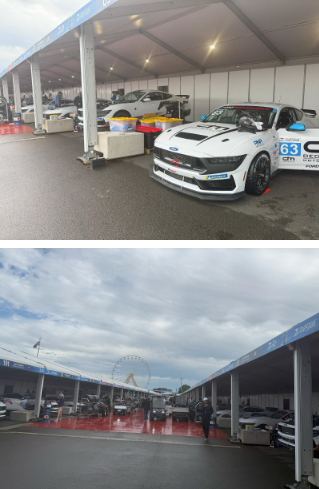
First, I had to find the place I was staying. I left the track around 6 p.m. and eventually found it after some effort. Then I realized I had no food—and discovered that grocery stores in the area close at 7:30 p.m.! I had less than 30 minutes to find one. Luckily, I made it just in time and grabbed sandwich supplies, some oranges, and, of course, a bottle of wine (when in France, right?). Back at the farmhouse, I realized it had no air conditioning (like many places in Europe), and the upstairs bedroom was way too hot for me, so I ended up sleeping on a futon downstairs. Shoutout to the rooster next door for ensuring I never overslept! It wasn’t the most comfortable experience, but definitely a memorable one.

On Wednesday, we had two practice sessions. I arrived at the track around 7:30 a.m. and immediately had to add Le Mans to the MoTeC dashes. I also made sure all the VBox HD2 systems had SD cards and were ready to go—I didn’t want any driver to miss their video data! The first practice went well, with Robert Noaker setting the fastest time. At 21 years old, Robert is the 2024 Mustang Challenge Champion and one of six Ford Performance Junior Drivers selected last year. He was the star of the event—more on that later.

I handled data for all five cars and coached Sandy Satullo, Joseph Dederichs, and Josh Hansen, who competed under the MotorCity Dark Horse Racing banner. Dan McKeever preferred to review his own data and video, and Robert didn’t really need much coaching (lol).

Le Mans is an 8.4-mile track, and with practice sessions only 45 minutes long, drivers could do a maximum of 8 laps at 4+ min lap times. None of them had driven the track before, so figuring out the racing line quickly was critical. Since the cars are all identical and only allow minor setup changes, lap time mostly came down to driving skill. Having Robert’s data was incredibly helpful for reference, and all drivers improved as the event progressed.

Of course, there were some hiccups. The cars use a street-style transmission, and 6th gear is an overdrive that drops revs by 2,800 RPM. This caused clutch slip issues, and Ford Performance engineers grew concerned about failures. The Noaker team ended up replacing two transmissions. To address the problem, Ford tried limiting top speed to 155 mph through changes in the MoTeC dashes. Unfortunately, something went wrong and the cars were limited to just 112 mph—not ideal at Le Mans! Ford reversed the changes, but by then only 15 minutes remained in the session. The organizers wouldn’t extend or add another session. That night, Ford engineers took two cars to a local airport to test a fix, which they successfully applied to all cars the next morning before qualifying. Drivers were then told to stay in 5th gear, which reduced the benefit of drafting—but at least everyone was on equal footing.
In qualifying, the fastest lap determined the Race 1 grid, and the second-fastest lap set the Race 2 grid. Robert set the quickest laps for both, but failed tech inspection due to a front splitter that was too low. His car had passed tech three times prior, so the most likely explanation is splitter damage during qualifying. However, inspectors also mandated lower tire pressures than in previous inspections, which may have contributed. Regardless, Robert would be starting both races from the back.
Under the Noaker tent:
- Josh Hansen qualified 9th in the Dark Horse class
- Sandy Satullo qualified 10th in the Dark Horse class
- Joseph Dederichs qualified 15th in Dark Horse Legends
- Dan McKeever took pole in Dark Horse Legends
Not bad with so little track time! And after reviewing data and video, I was confident everyone could go faster.
Race 1 took place Saturday morning, and I have to say—being on pit lane at Le Mans was incredible. The 24 Hours of Le Mans teams were all working out of pit lane garages, and it was cool to see their cars in various states of disassembly. Their crew members were just as curious about our cars as we were about theirs. Thirty-nine Mustangs with 500+ HP V8s launched into Turn 1—it was quite a spectacle.

I have Robert’s in-car footage, and his charge from 39th was phenomenal. He finished 7th and might have won if not for slow zones and the 155 mph limiter. Sandy took 0.7 seconds off his best time and moved up to 9th. Joseph dropped 4 seconds (!) and climbed to 13th in class. Dan improved by nearly a second and finished 2nd in class. Josh took 1.1 seconds off his time but had an incident and couldn’t start Race 2.
Watch Race 1 here: https://www.youtube.com/live/V9Fzno_x7z4?si=XVBSkjMXjW_dHoRV

Race 2 saw Robert starting from 37th due to a couple of DNS cars. I don’t have exact starting positions for the others, but Sandy finished 7th in class and cut 1.7 seconds off his time. Joe finished 9th in class, improving by 2.7 seconds. Dan, unfortunately, was involved in a Lap 1 incident and couldn’t continue. As for Robert—he passed 14 cars before the Mulsanne Straight. That’s just five corners! He climbed all the way to 2nd before a slow zone. When the green came back, the leader missed the signal and Robert took the lead! They battled hard until the finish, with Robert taking 2nd and setting the fastest lap of the race—and the entire event. A phenomenal drive.
Race 2 video: https://www.youtube.com/live/6F4a7Z6Irig?si=YPts2AvEXrKp1wLl

The event ended on a high note. After finishing my duties, I had time to explore and catch the start of the 24 Hours of Le Mans. The crowd was enormous—it was hard to even see the track! Still, it was great to soak it all in. But I was definitely ready to get back to air conditioning—and no roosters (lol).
I’ve included a few photos in this article, but you can check out the full album (with some videos) here:
📸 Dropbox Photo Album
Enjoy—and good luck in your races!