
March Madness on Track: 12 Hours, 1 Crash, and a New Car
As I mentioned in my last email, March was going to be busy—and it certainly delivered.
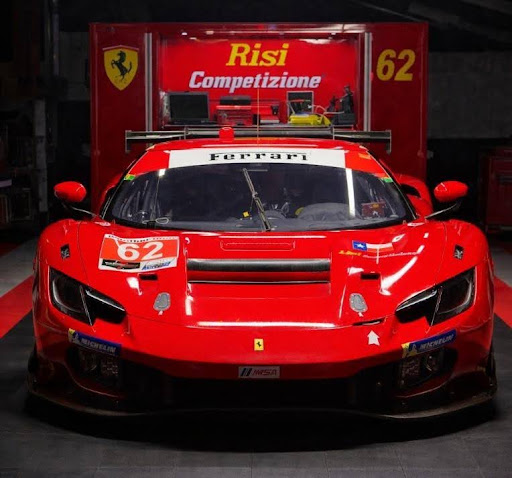
The 12 Hours of Sebring took place the weekend of March 21st, where I was again working with Risi Competizione as Performance Engineer. Unlike the 24 Hours of Daytona, we had very limited testing time—just three sessions to get the car dialed in. As part of the Balance of Performance (BoP), we were required to run the minimum rear wing angle, which is not something we would typically choose at Sebring.
Surprisingly, the car performed better than expected under those constraints, and we felt the overall balance was reasonably strong heading into the race.
We qualified 7th in GTD Pro, just one tenth off the fastest Ferrari 296 GT3 running in the GTD class. Unfortunately, during the third hour, while running 9th, we were passing a competitor on the inside of Turn 17 when that car appeared to spin and come across our nose. We spun as a result and were then clipped in the right rear by another car. The impact caused suspension damage and ended our race far earlier than expected.
It was a disappointing outcome, but perseverance is part of racing, and Risi Competizione will be back at Watkins Glen in June.
From a personal standpoint, there were positives. I had spent significant time developing tools to evaluate virtual energy usage, and those were performing very well. Based on the data, we were in a position to move forward through the field. It’s unfortunate we didn’t get the opportunity to see how that would have played out over a full race distance.
Immediately after Sebring, I transitioned to my next event: GT World Challenge America with Chicago Performance and Tuning at Sonoma Raceway the following weekend. There was no time to return home—I flew directly to California on Sunday after the race.
CPT was running a Lamborghini Huracán GT3 EVO2, which was new to the team. We completed a shakedown at Willow Springs on Tuesday prior to the Sonoma event. Getting the car there at all was an achievement in itself—the team had only received it a few weeks earlier, and it arrived in less-than-ideal condition. Credit to the CPT crew for getting everything turned around in time to compete.
Loris Spinelli, Lamborghini factory driver, joined us to support the program and was instrumental in accelerating our understanding of the car. Our drivers, Nicolai Elghanayan and Mads Siljehaug, adapted quickly, and we were able to continue refining the setup to suit their preferences.
As expected with a new platform, we encountered a few technical challenges. On my end, the primary issue was that the MoTeC logger was not capturing all of the data channels we needed. That forced me to adapt my workflow and find alternative ways to analyze performance.
The Huracán uses a Bosch system, which meant working in WinDarab—a platform I hadn’t used previously. While all data analysis tools ultimately serve the same purpose, there’s always a learning curve in figuring out how to extract what you need. After some initial ramp-up, I was able to build math channels and uncover key handling insights that helped guide our setup direction.
I still have more to learn with WinDarab, but given how widely Bosch systems are used across motorsport, developing that capability will be valuable moving forward.

The Lamborghini Huracan GT3 EVO2 really is a cool car. Check out Mads Siljehaug hounding and passing a couple of Porsches at the SRO GTWCA race at Sonoma! And listen to that Lamborghini V10 sing!!
Btw, Nicolai Elghanayan has only signed up for Sonoma, Road America, and Indy so CPT is looking for another driver to share the driver’s seat with Mads for the other events. Please reach out to CPT’s Team Manager, Chris Lester, at chris@gocpt.com if you are interested.