
Reading the Radius: A GPS-Based Look at Cornering Technique
I have talked a lot about using information from many different channels, but is GPS data alone valuable? Absolutely. In this article, I want to get back to basics and show how RPM and GPS data can be used to interpret driver performance.
For this example, I am comparing a professional driver, shown in blue, to an amateur driver, shown in yellow. I have zoomed in on Turn 1 at Circuit of the Americas, where the pro driver was 0.32 seconds faster than the amateur driver through the sector.
Exhibit 1 shows the GPS traces for each driver through Turn 1. In the Time/Distance graph, I have included RPM, speed, lateral acceleration, longitudinal acceleration, combined G, and corner radius. The time compare trace is shown at the bottom.
Combined G and Corner Radius are both math channels. The AIM formulas are:
Combined G:
sqrt((“GPS LatAcc”[g]^2)+(“GPS LonAcc”[g]^2))
Corner Radius:
(“GPS Speed [mph]”*1.46667)^2)/(“GPS LatAcc [g]”*32.17405)

Exhibit 1
One of the first things I like to look at is the line each driver took through the corner. In Exhibit 2, I zoomed in on the entry of the corner. You can see that the amateur driver crept into the corner, which prevented him from opening the radius as much as the pro driver.
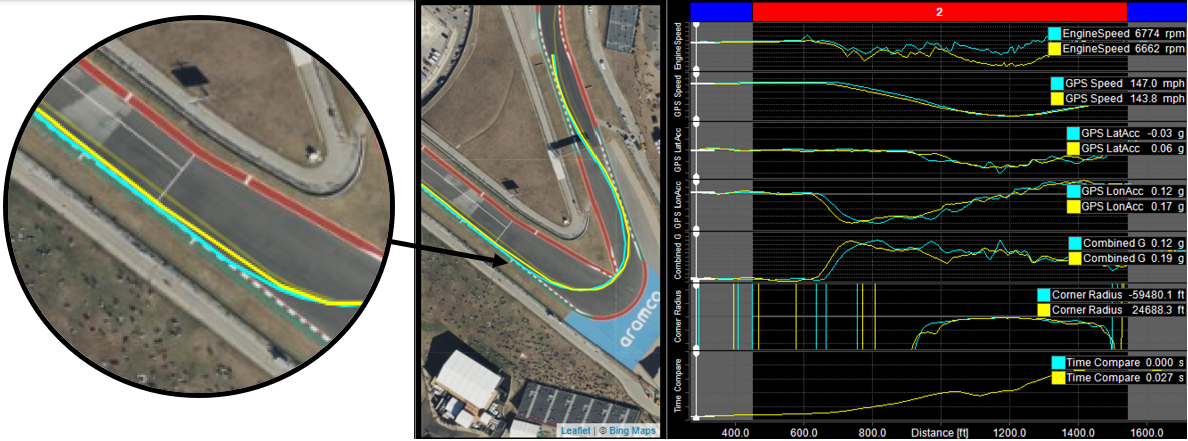
Exhibit 2
In reality, the amateur driver appears to have recognized that he was creeping into the corner and then straightened the car slightly to adjust. This can be seen in both the GPS LatAcc trace and the Corner Radius trace. The Corner Radius trace also shows that the amateur driver began turning earlier, which matches what we see in the driving line.
In Exhibit 3, I have zoomed in on the GPS LatAcc and Corner Radius traces so these differences are easier to see.

Exhibit 3
Some of the more obvious differences between the two drivers are that the pro driver carried more speed into the corner by braking later, while also using a lower gear on entry. The lower gear likely provided more engine braking on corner entry and gave the car a stronger launch on exit.
However, I want to focus more specifically on what can be learned from the Corner Radius trace.
In Exhibit 4, I changed the Corner Radius scale from -2500 to 2500 to -20,000 to 0. This isolates the left-hand corner and also captures the point where the cars begin to change direction. A radius of 20,000 feet is not much of a turn, so this scale makes it easier to identify the initial turn-in point.
By doing this, I was able to measure the distance between when the amateur driver started turning and when the pro driver started turning. The amateur driver turned in 43 feet before the pro driver.
This view also shows that the amateur driver actually turned the car slightly to the right twice before entering the corner. The two yellow spikes and one blue spike before the main turn-in point show that the cars were moving around under braking. I included the GPS LonAcc trace so it is easier to see that these spikes line up with the braking phase.
By the way, I manually removed the vertical lines that appear when the car is traveling straight so these smaller movements are easier to see.

Exhibit 4
If I want to see more detail about what is happening while the car is actually going through the corner, I can change the Corner Radius scale to -1000 to 0. This still isolates the left-hand corner, but it also zooms in on the cornering phase itself.
Exhibit 5 shows this view. One thing that stands out is that both cars have slight oversteer moments on corner exit, with the pro driver dealing with a little more of it. These oversteer moments are most likely related to the aggressiveness of the throttle application rather than a setup issue.
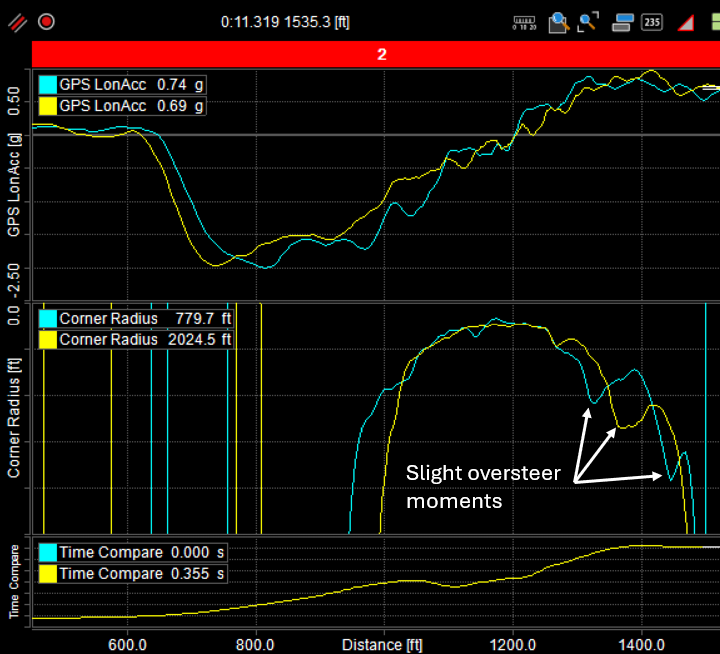
Exhibit 5
The key takeaway is that even with a very basic data set, there is still a lot that can be learned. RPM and GPS data can show braking points, minimum speed, throttle application trends, gear selection, corner entry behavior, line choice, and even small corrections that may not be obvious from speed alone. More channels can certainly add detail, but they are not always required to start asking better questions. If you know what to look for, simple GPS-based channels like lateral acceleration, longitudinal acceleration, combined G, and corner radius can provide a clear picture of how and why one driver is gaining time over another.